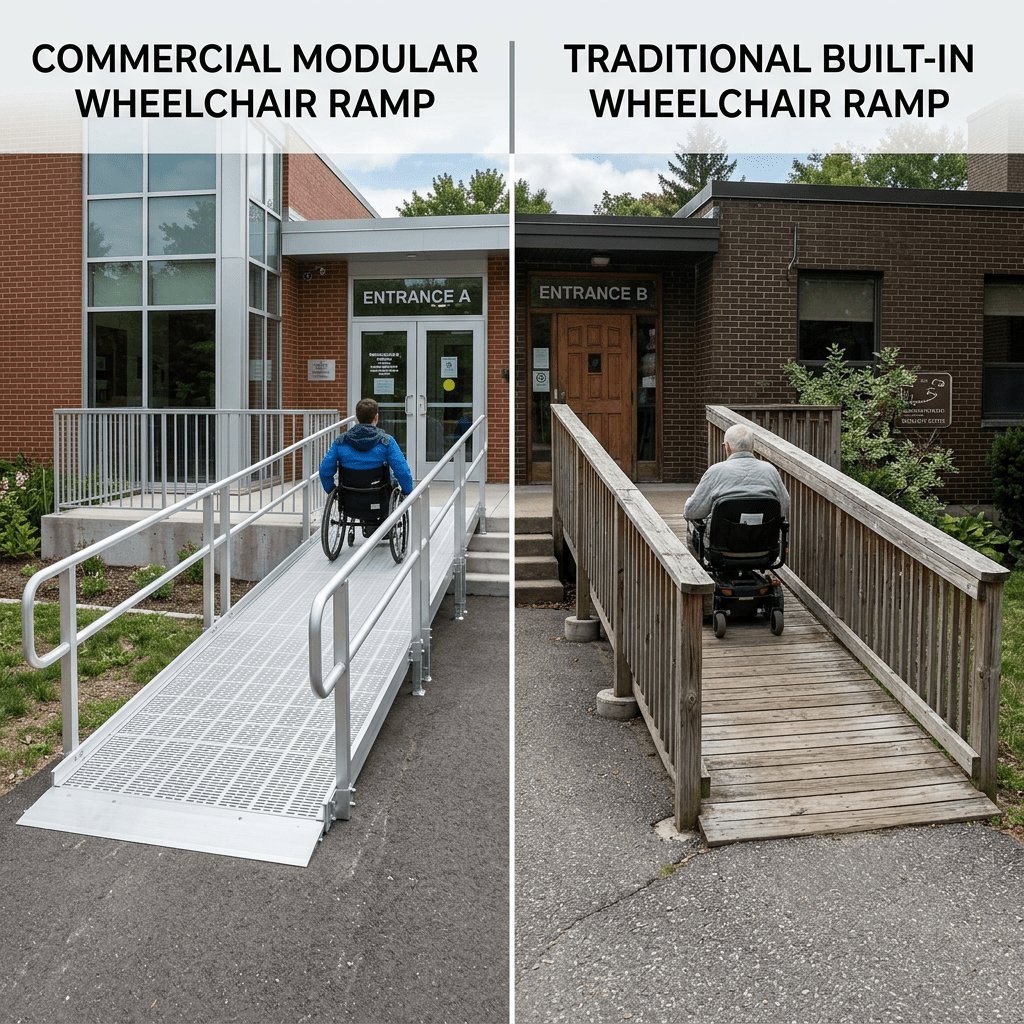
Making a commercial property accessible is more than just meeting legal requirements. It creates a welcoming environment for customers, employees, patients, and visitors of all abilities. If you’re planning an accessibility upgrade, one important question comes up: Should you choose commercial modular wheelchair ramps or traditional commercial ramps?
The answer depends on your building, budget, installation timeline, and long-term accessibility goals. While both options can provide safe wheelchair access, they differ in design, flexibility, maintenance, and ADA compliance.
In this guide, we’ll compare commercial modular wheelchair ramps and traditional commercial ramps to help you understand which solution best fits your property while supporting ADA accessibility standards.
Understanding Commercial Modular Wheelchair Ramps
Commercial modular wheelchair ramps are pre-engineered ramp systems made from durable materials such as aluminum or galvanized steel. These ramps consist of modular sections that can be assembled, expanded, relocated, or modified without major construction.
Unlike permanent concrete ramps, modular systems are manufactured in sections and installed on-site, making them a popular choice for businesses, schools, hospitals, churches, government buildings, and healthcare facilities.
Common features include:
- Slip-resistant walking surfaces
- ADA-compliant handrails
- Modular platforms and landings
- Adjustable heights
- Weather-resistant materials
- Easy expansion for future needs
Because they are designed for flexibility, modular ramps continue to grow in popularity across commercial properties throughout the USA.
What Are Traditional Commercial Ramps?
Traditional commercial ramps are permanent structures typically built using poured concrete or masonry during the construction phase of a building. They become part of the property’s infrastructure and are designed for long-term use.
These ramps are commonly found at:
- Office buildings
- Shopping centers
- Schools
- Municipal buildings
- Apartment complexes
- Medical facilities
Concrete ramps offer durability and a permanent appearance, but they usually require extensive site preparation, permits, labor, and longer installation times.
Why ADA Compliance Matters
The Americans with Disabilities Act (ADA) establishes accessibility standards for commercial buildings in the United States.
ADA-compliant ramps generally require:
- Maximum slope of 1:12
- Minimum clear width of 36 inches
- Level landings at required intervals
- Handrails for longer ramps
- Stable, slip-resistant surfaces
- Edge protection where necessary
Failure to meet ADA standards may create accessibility barriers and increase legal risk for property owners.
Whether you choose modular or traditional construction, proper ADA compliance is essential.
Commercial Modular Wheelchair Ramps vs. Traditional Commercial Ramps
Let’s compare the two options across the most important decision factors.
| Feature | Commercial Modular Wheelchair Ramps | Traditional Commercial Ramps |
| Installation | Fast | Slow |
| Flexibility | Excellent | Very Limited |
| Future Expansion | Easy | Difficult |
| Relocation | Possible | Not Possible |
| Initial Construction | Minimal | Extensive |
| Maintenance | Low | Moderate |
| ADA Adaptability | High | Depends on Design |
| Cost Predictability | High | Can Vary |
Installation Time
One of the biggest differences is installation speed.
Commercial Modular Wheelchair Ramps
Since these systems arrive as prefabricated components, installation often takes only a few days, depending on the project size.
Benefits include:
- Less disruption to business operations
- Reduced labor costs
- Faster project completion
- Minimal excavation
Traditional Commercial Ramps
Concrete ramps require:
- Site excavation
- Formwork
- Concrete pouring
- Curing time
- Inspections
The entire project may take several weeks before the ramp is ready for use.
If your facility needs accessibility improvements quickly, modular systems often provide a significant advantage.
Flexibility for Future Changes
Buildings change over time. Entrances move, expansions happen, and accessibility needs evolve.
This is where commercial modular wheelchair ramps truly stand out.
They allow you to:
- Add new sections
- Extend ramp length
- Reconfigure layouts
- Move ramps to another entrance
- Relocate the entire system if necessary
Traditional concrete ramps cannot easily adapt to these changes. Modifying them usually involves demolition and rebuilding.
Cost Comparison
Many property owners ask:
Which option is more affordable?
The answer depends on your project.
Modular Ramp Costs
Commercial modular wheelchair ramps typically offer:
- Lower labor expenses
- Faster installation
- Predictable project pricing
- Reduced site preparation
Traditional Ramp Costs
Concrete ramps may involve:
- Engineering fees
- Excavation costs
- Concrete work
- Permit delays
- Landscaping repairs
Although some permanent ramps can be cost-effective for new construction, renovation projects often favor modular systems because they reduce overall project complexity.
Durability and Maintenance
Both ramp types are built for commercial use, but maintenance requirements differ.
Modular Systems
Modern aluminum ramps offer several advantages:
- Rust resistant
- Weather resistant
- Easy to clean
- Non-slip surfaces
- Long service life
Routine inspections are usually all that’s needed.
Concrete Ramps
Concrete is extremely durable but can develop:
- Surface cracks
- Water damage
- Freeze-thaw deterioration
- Uneven settling
Periodic repairs may be necessary over time.
Safety Features
Accessibility is only one part of the equation. Safety is equally important.
High-quality commercial modular wheelchair ramps commonly include:
- Continuous handrails
- Slip-resistant decking
- Stable walking surfaces
- Proper edge protection
- Landing platforms
- Drainage-friendly design
Traditional commercial ramps can include the same safety features but require careful planning during construction.
Regardless of the ramp type, professional installation and regular inspections help ensure user safety.
Best Applications for Commercial Modular Wheelchair Ramps
These ramps are ideal for many commercial settings, including:
- Hospitals
- Medical clinics
- Schools
- Churches
- Government facilities
- Hotels
- Restaurants
- Retail stores
- Office buildings
- Temporary event venues
For example, imagine a healthcare clinic that adds a new patient entrance after expanding its facility. Instead of demolishing concrete and rebuilding the access route, the clinic installs a modular ramp system in just a few days, minimizing disruption to patients and staff.
When Traditional Commercial Ramps Make Sense
Traditional commercial ramps may still be the better choice when:
- Constructing a brand-new building
- Permanent architectural integration is important
- Long-term site design has already been finalized
- Major renovations are already underway
Many architects continue to specify concrete ramps for large commercial developments where accessibility is incorporated into the original building design.
Environmental Benefits
Sustainability has become increasingly important for commercial construction.
Commercial modular wheelchair ramps can reduce environmental impact by:
- Generating less construction waste
- Reusing components
- Reducing demolition materials
- Supporting future relocation instead of replacement
Because modular systems can often be reused, they may contribute to more sustainable building practices over time.
Expert Tips Before Choosing a Ramp
Before making a decision, consider these practical recommendations:
- Evaluate your available space carefully.
- Measure the total rise from ground level to the entrance.
- Review ADA requirements with a qualified accessibility professional.
- Think about future building expansions.
- Choose corrosion-resistant materials for outdoor installations.
- Select experienced installers familiar with ADA standards.
- Schedule regular inspections after installation.
Planning ahead can save significant time and money later.
Common Mistakes to Avoid
Many businesses unintentionally create accessibility issues by making avoidable mistakes.
Watch out for:
- Choosing ramps with incorrect slopes
- Ignoring landing requirements
- Installing inadequate handrails
- Selecting low-quality materials
- Forgetting future accessibility needs
- Hiring inexperienced contractors
Avoiding these issues helps ensure long-term compliance and user safety.
Which Option Is Best for ADA Compliance?
If flexibility, faster installation, and future adaptability are priorities, commercial modular wheelchair ramps are often the stronger choice.
They make it easier to achieve ADA compliance while reducing construction time and minimizing disruption to business operations.
Traditional commercial ramps remain an excellent option for permanent new construction projects where architectural integration is a primary objective.
Ultimately, the best solution depends on your property’s layout, budget, accessibility goals, and long-term plans.
Frequently Asked Questions
Are commercial modular wheelchair ramps ADA compliant?
Yes. High-quality commercial modular wheelchair ramps can fully comply with ADA requirements when properly designed and installed according to current accessibility standards.
How long do commercial modular wheelchair ramps last?
Most aluminum modular ramps can last for decades with proper maintenance. Their corrosion-resistant construction makes them suitable for outdoor commercial use.
Can modular ramps be moved to another location?
Yes. One of the biggest advantages of modular systems is that they can often be disassembled and relocated if your building layout changes.
Are traditional commercial ramps more durable?
Concrete ramps are highly durable, but modular aluminum ramps also provide excellent longevity while requiring less maintenance and offering greater flexibility.
Which ramp is better for an existing commercial building?
For most retrofit projects, commercial modular wheelchair ramps are often the preferred solution because they install quickly, require less site work, and can adapt to existing building layouts.
Conclusion
Choosing between commercial modular wheelchair ramps and traditional commercial ramps comes down to your property’s unique needs. While both options can provide safe and ADA-compliant accessibility, modular systems offer unmatched flexibility, quicker installation, lower disruption, and easier future modifications.
For many businesses, healthcare facilities, schools, and public buildings, commercial modular wheelchair ramps provide a practical, cost-effective solution that supports long-term accessibility goals without extensive construction. Before making your final decision, consult an ADA accessibility specialist or experienced ramp provider to ensure your project meets all applicable standards and delivers safe, reliable access for every visitor.
 Men Xp